Data-driven rationale for why the Commanders should not fire Dan Quinn
Washington is 1-3-1, and the calls to fire Quinn are getting louder. But the weight of the evidence says moving on now would be a big risk. It would break up the best quarterback-coach pairing the franchise has had in more than three decades.
By Kevin Klein · · Data through Week 5
Well, just one week after I built a tool that helped Washington sports fans illuminate just how exceptionally miserable they are, the local football team put an exclamation point on it by authoring one of the most inexplicable time-management goat rodeos a football field has ever seen. Predictably, the city has erupted into one of its favorite pastimes: bloodlust. This time, their sights are set on Dan Quinn.
I'm here to take a step back and provide a data-driven explanation for why I don't believe firing Dan Quinn would be a prudent move for the organization (although I understand the bloodlust…really, I do). I won't make you wait to understand the rationale. Here it is up front: it's a critical time in the organization's growth curve, with their superstar quarterback eligible for a contract extension after this season, his rookie deal running through 2027 and a fifth-year option that could keep him under it through 2028. Consistency of leadership offers far more upside than installing change, in particular given the recency of the franchise's most successful season in 35 years, and the confounding variable of injuries that have plagued them since that moment.
To test that, I built a dataset of every NFL head-coach exit from 1996 to 2025, 246 in all, and tracked what happened next.
But first, a quick reminder of the landscape of futility that preceded Quinn’s arrival in 2024.
Washington since 1992: nothing else looks like 2024
Wins each season since the year after Washington's last Super Bowl. Regular-season wins form the bar; each playoff game is stacked on top. Hover for details.
Regular-season winsPlayoff winPlayoff loss that ended the seasonBest regular season, 1992–2023 (10 wins)
Washington, season by season
Win percentage. Below each bar: league rank in Adjusted Games Lost to injury (1 = most injured) and, since 2024, Jayden Daniels' starts.
1
Bad teams bounce back whether or not they fire the coach
So, even moving on from what Quinn accomplished in year one in Washington, let’s generalize out to bad teams, and what happens when they do or when they do not fire their head coach.
Losing seasons tend to be followed by better ones. Luck evens out, injured players come back, the schedule gets easier. The question is whether a new coach adds anything on top of that.
Since 1996, 127 teams with a .400 record or worse fired their coach. The next season they won of their games on average. The 154 equally bad teams that kept their coach won . The playoff rates are nearly identical too.
Where bad teams landed the next season
Each dot is a team that finished .400 or worse, 1996–2024, placed by its win percentage the following season. Hover for details.
Kept the coachFired the coachAverage
Show as table
Note Firings are non-interim, non-voluntary exits; teams that changed coaches for any other reason are excluded from the "kept" group. Fired teams started a little worse (.255 vs. .291) and so had more room to rise, which makes the identical finish more telling, not less.
2
Coaches who reached a title game, then slumped, usually came back
Quinn isn't a generic struggling coach. He's one who reached a conference championship and then had a losing season. That's happened 21 times since 1996 where the team kept the coach for another year and that year is complete.
Those teams went from to the following season, and made the playoffs. That's nearly double the playoff rate of teams that fired their coach. The list includes Andy Reid, Sean McVay, Kyle Shanahan (twice) and Mike McCarthy.
Win percentage in the losing season, and the year after
Coaches who reached a conference title game or Super Bowl, had a losing record the next season, and were kept. Washington's 2026 is five games old.
Made the playoffs the next yearMissed the playoffsWashington, 2025–26 so far
Show as table
There's one caveat. Washington is a step further down this road than most of these teams. 2026 is Quinn's second season since the title game, not his first. And he got there in his first season with the team, which narrows things further. Only three coaches have followed his exact path. Each reached a title game in year one, had no winning record in years two and three, and was kept for year four.
The only coaches who walked Quinn's path
Reached a conference title game in their first season with the team, had a losing second season, and were kept.
Year 1
Year 2
Year 3
Year 4
Jon GrudenBuccaneers, 2002–05
12-4Won Super Bowl
7-9
5-11
11-5Playoffs
Sean PaytonSaints, 2006–09
10-6Lost NFC title game
7-9
8-8
13-3Won Super Bowl
Doug MarroneJaguars, 2017–20
10-6Lost AFC title game
5-11
6-10
1-15Fired
Dan QuinnWashington, 2024–
12-5Lost NFC title game
5-12
1-3-1so far
?
None of the three made the playoffs in year three, the year Washington is in now. Two of the three had a big year four, with Gruden back in the playoffs and Payton a Super Bowl champion. Obviously a sample size of three is untrustworthy, but it’s the closest history we got. The broader group of title-game coaches who had a second bad year is tougher, and I take it on in section 6.
3
Washington is in its second straight injury season, and that's when firing has worked worst
By Football Outsiders' Adjusted Games Lost, Washington was the third-most injured team in the NFL last season. Sports Info Solutions, which weights injuries by how valuable the missing players were, ranked it second, mostly because of Jayden Daniels.
That matters because firing after an injury-wrecked season has the worst track record of any scenario in the data. Bad teams with top-10 injury totals that fired their coach won the next year. Those that kept their coach won . A new coach can't fix a training-room problem; the old coach gets the healthy roster back.
Adjusted Games Lost, 2025
All 32 teams, most injured first.
Bad teams' next season, by injuries and decision
Teams at .400 or worse. Dot = win % the next season; line starts at the bad season.
The raw injury count also undersells what Washington lost, because the injuries hit the most important position. Daniels started of 17 games in 2025 and has missed two of five this year.
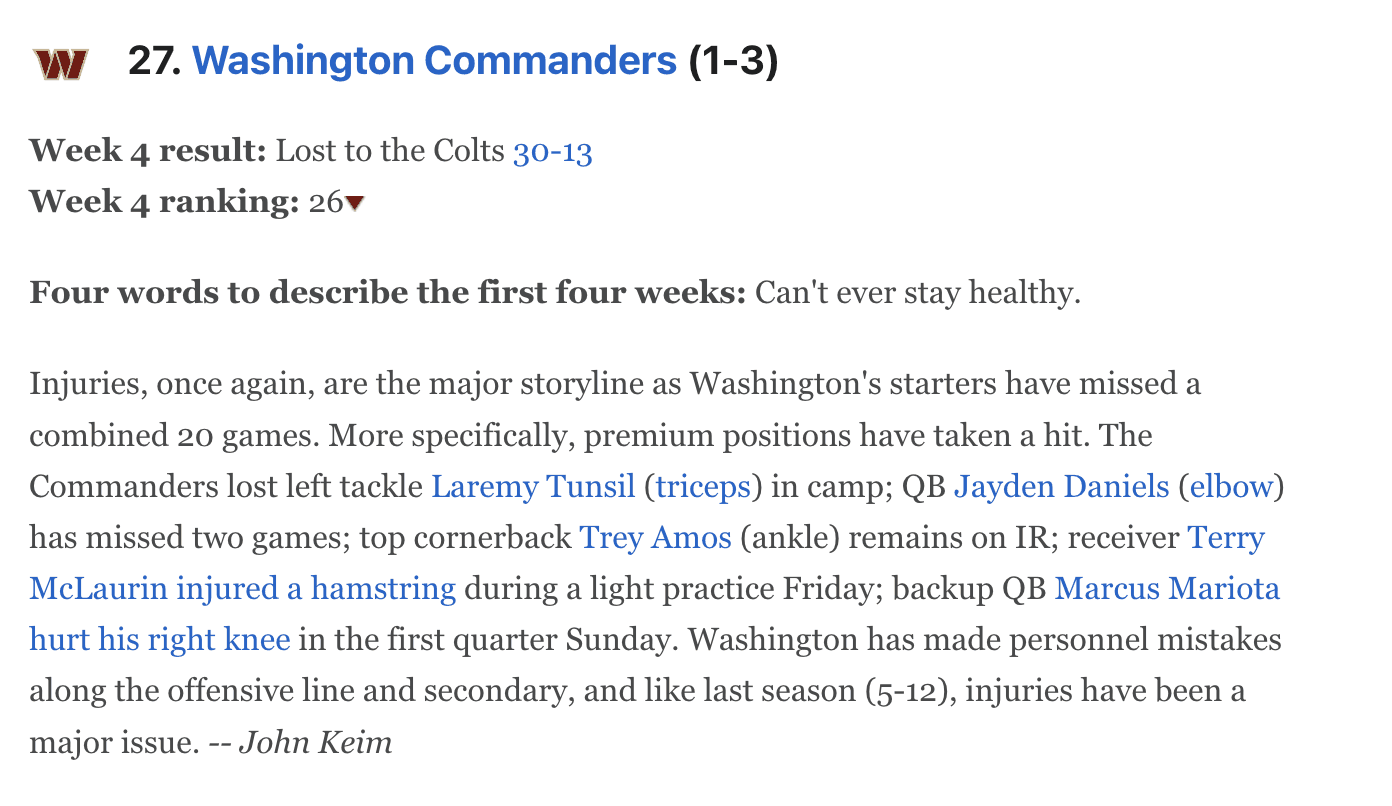
So far, 2026 looks like another injury season. Washington is without key pieces in left tackle Laremy Tunsil, top cornerback Trey Amos and top receiver Terry McLaurin. When backup Marcus Mariota hurt his knee in Week 4, Washington finished the game with its third-string quarterback, seventh-round rookie Athan Kaliakmanis. And Daniels' health is tenuous. This is the second time he has dislocated that elbow, and ESPN's Adam Schefter has reported that he will likely need surgery after the season.
John Keim, ESPN NFL Power Rankings, Week 5, 2026
Look only at bad teams where no quarterback started more than 10 games, because of injury or a benching. The ones that kept their coach made the playoffs the next season of the time, more than any other group. The ones that fired him made it .
Made the playoffs the next season
Teams at .400 or worse, 1996–2024, by whether their quarterback situation held together.
Note "Top-10 injured" = league top 10 in AGL that season. AGL couldn't be recovered for 2001–2007 and 2009. "QB disrupted" = the team's most-used starter started 10 or fewer games; that includes benchings as well as injuries. Source Football Outsiders / FTN Adjusted Games Lost; Sports Info Solutions; 2026 injuries from ESPN and CBS Sports.
4
Young quarterbacks have done better when their coach stayed
Everything in Washington runs through Daniels, who becomes eligible for a contract extension after this season. The data has 99 cases of a promising young quarterback (first- or second-round pick, in his first four seasons, nine-plus starts) on a team that just had a bad year.
When the coach was kept, the quarterback's passer rating rose more the next season, his team won more, and he was more likely to get a second contract from that team. Since 2021 new coaches have revived a handful of young passers (Tua Tagovailoa, Justin Herbert, Trevor Lawrence, Drake Maye), so this isn't a law of nature. But the long-run edge belongs to continuity.
Young QB outcomes, coach kept vs. fired
Coach kept (46)Coach fired (53)
Note Rating change only counts quarterbacks who stayed the starter. "Got a second contract" counts decided cases only (41 in each group) and excludes QBs extended before the decision. Several contract outcomes were compiled partly from memory by research agents and are flagged in the raw data.
5
Few franchises change coaches as often as Washington
Counting Quinn, Washington has had head coaches since 2000. Only the Raiders and Browns have had more. The league average is . The Steelers, Ravens, Packers and Patriots have had three each.
Stability and winning feed each other, so this chart can't prove that patience causes success; good teams keep their coaches. But the churn hasn't bought Washington anything. In 26 seasons from 2000 to 2025, it had . Firing Quinn would move it into third place on its own, and feel like a continuation of the knee-jerk Snyder era, instead of what’s supposed to be a more considered approach to decision making from Josh Harris and company, who would be firing their second head coach in four seasons of ownership.
Head coaches since 2000
Each square is one head coach. Interim coaches who weren't kept don't count; a coach with two separate stints counts twice. Hover for names.
WashingtonOther franchisesIf Quinn is fired
Note Counts through Week 5 of 2026. The Texans began play in 2002. The Saints' 2012 fill-ins during Sean Payton's suspension aren't counted.
6
The case has an expiration date
The strongest objection is in the same data. Eight title-game coaches had a second straight losing season. Only , Jon Gruden with the 2005 Buccaneers, led his team back to the playoffs the year after. (Sean Payton's Saints, from section 2, don't count here, since they went 8-8 in his third year, not a losing record.) Green Bay also got back, but under Matt LaFleur, after firing Mike McCarthy. And one of the eight was Mike Smith in Atlanta. The Falcons fired him after his second losing year and hired Dan Quinn, who took them to the Super Bowl in his second season.
But those eight mostly weren't Washington's situation. In seven of them, one quarterback started at least 12 games of the second losing season. The exception was Gruden's 2004 Buccaneers, whose starter made just 10 starts. They were the one team that bounced back under the same coach. Daniels' availability has already been questionable this season. He missed two games with the elbow, and he's now playing on a joint he has dislocated twice, putting off surgery until after the season. Those are circumstances that make more missed time likely, which sets Washington up for another season where it's hard to read the strength of its healthy roster. The other 2026 injuries are at premium positions, too, with left tackle Laremy Tunsil out since camp, top cornerback Trey Amos on IR and top receiver Terry McLaurin nursing a hamstring.
So 1-3-1 isn't nothing, especially with the ugly clock-management gaffe that took a win off the board against the Giants. But a fair verdict on Quinn needs a clean read, meaning a stretch where Daniels and the premium pieces around him are actually on the field. The most likely version of this season isn't that. With Daniels playing on a twice-dislocated elbow and surgery likely waiting after the season, 2026 is shaping up as another year that's hard to read. If it ends that way, the case for patience carries into the offseason, too, and Quinn deserves a healthy 2027 before anyone decides. Only a clearly losing record with a mostly healthy Daniels would take the injury explanation off the table. Short of that, 2024 was too good and everything since has been too murky to call it a fluke. Washington's best chance of getting back to that level likely runs through the people who got it there the first time, as the conditions largely outside their control drift back toward neutral.
And the decision is bigger than one man. Firing a head coach almost always means replacing his staff. In 141 of 175 firings since 1996, the new coach replaced both coordinators. That's the most common outcome by far, and one of the worst. Teams whose new coach kept one of the old coordinators made the playoffs more often the next year, and promoting a coordinator to head coach has gone worst of all. In Washington's case, a new coach moving on from first-year coordinators David Blough and Daronte Jones would be a real possibility. That would give Daniels his second head coach and his third offensive coordinator in four seasons, an insane amount of leadership change to start a quarterback's career. Washington has seen this movie before. Jason Campbell went through three offensive systems in his five seasons here, and that kind of churn was a hallmark of the Snyder era.
What the next staff looked like after a firing
All 175 firings from 1996–2024 with a completed next season, grouped by what happened to the old coordinators. Left, how often each happened; right, how often those teams made the playoffs the next year. *Only two new coaches kept both coordinators, too few to read much into.
7
Consistency is the better bet
Net net, Quinn had an exceptional level of success when the confounding variable of injuries was favorable for him. It hasn’t been favorable since, especially at quarterback, and the results have shown it. Not necessarily an excuse, but certainly important context when weighing a franchise-altering decision such as a head-coach firing.
Change at the top begets change at the supporting management layers (new coaches replaced both coordinators in 141 of 175 firings since 1996), which would all come, theoretically, as Jayden Daniels enters year four. The data bears out that, in situations like this one, consistency at this stage provides a better chance for success than upheaval, and the Commanders shouldn’t overreact to what was an admittedly catastrophic on-field failure.
If they are going to make that kind of decision, they should do it from a clean data set, one where injuries aren’t muddying the picture as much, lest they move too quickly away from the QB-coach battery that, in a one-year sample of clean data, has gotten it right more than any tandem in more than three decades.
How this works
The data
The dataset covers every NFL head-coach exit from 1996 through the 2025 season, 246 in all, including firings, forced resignations, "mutual partings" and interims who weren't retained. For the next-season comparisons I use one firing per team-season, excluding interims and voluntary retirements, which leaves 175 firings with a completed next season. "Kept" teams are every team at .400 or worse that made no coaching change. A season belongs to the year it started, so a January 2026 firing counts as 2025.
Caveats
Win percentage is a noisy measure; point differential or DVOA would be better. Several groups are small (the title-game cohort is 21 teams, the two-losing-years group 8), so read differences as directional. Coordinators come from Pro Football Reference, except 2011–2015, which came from profootballarchives.com. Some firing dates and quarterback contract outcomes were compiled from research agents' memory and are flagged in the raw files. 2026 records are through Week 5.